
Tarrant County Court Records After Arrest
The custody-to-court path in Tarrant County starts with arrest and jail booking, then magistration, then prosecutor or court filing. The jail roster shows the custody-side record: name, CID, facility, mugshot if available, active booking charge rows, bond type, amount, and holds. The court record is separate. It may show a different formal charge from the arrest charge because the Tarrant County Criminal District Attorney evaluates the allegation and files or presents the charge through the appropriate court process.
For custody and booking data, use Tarrant County jail inmate records. For booking photos, use the Tarrant County jail mugshots page. Court records after a jail arrest focus on the case record: charge filing, case number, court assignment, bond decisions, warrants, case status, dismissals, pleas, judgments, and eligibility for restricted access such as expunction under Texas law.
Magistration After Tarrant County Arrest
Magistration is the first court-adjacent stage after jail arrest. Texas Code of Criminal Procedure Article 15.17 requires that an arrested person be taken before a magistrate without unnecessary delay and generally within 48 hours. The magistrate gives warnings, addresses rights, and sets or reviews bail. This stage can appear before a formal case is easy to find in a court portal.
The Tarrant County magistration docket is housed on the same county inmate-search domain. It refreshes every 300 seconds and lists CID, last name, first/middle name, time, charged offense, and agency. It is not the full court case file, but it is a strong bridge between the jail booking and later court records after a jail arrest.
The official Tarrant County magistration docket shows the daily first-appearance listing:
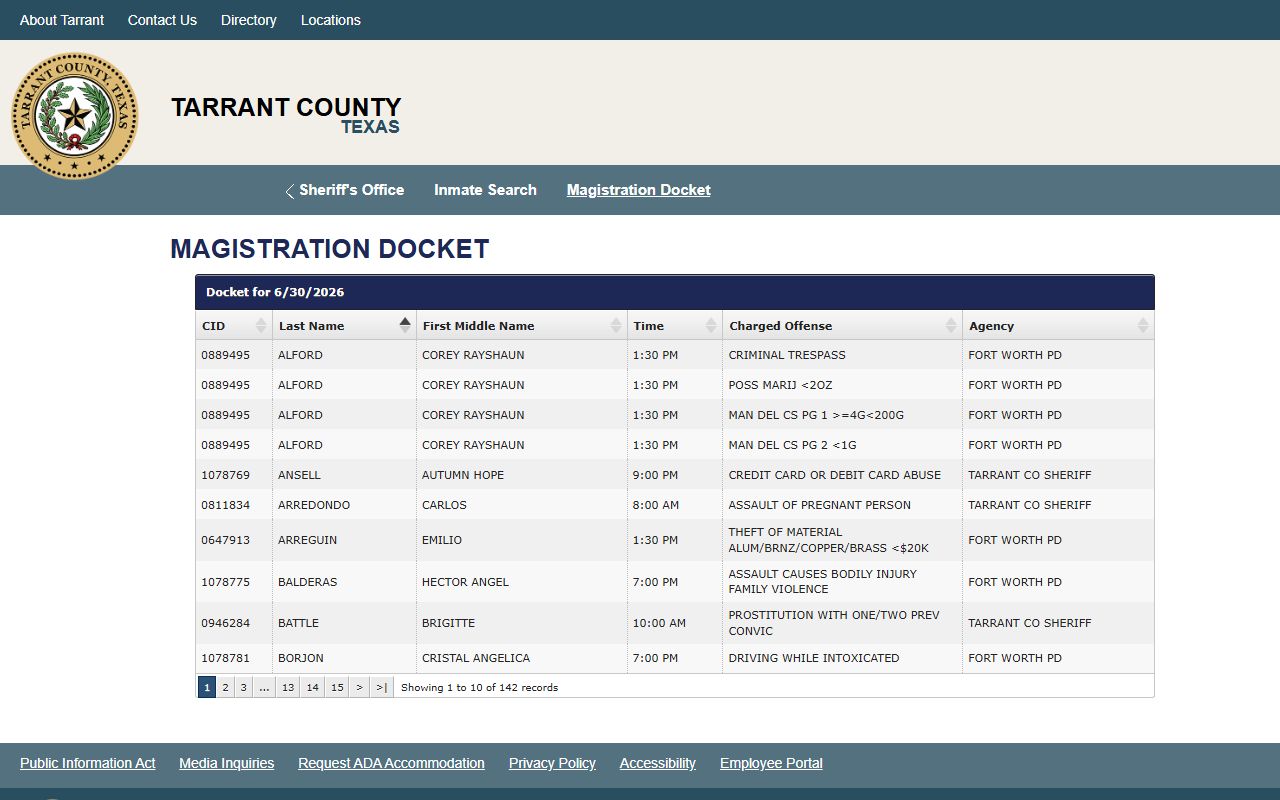
Use the docket fields to confirm the early hearing stage, then move to the court portal or clerk channel for the formal case record.
Find Court Records After Arrest
Tarrant County links the Tyler PublicAccess portal for County Courts at Law records, Justice of the Peace records, and Probate Court records. District Clerk subscriber access is available at dcsa.tarrantcounty.com for district court access. The correct court search path depends on charge level and court assignment. Misdemeanor cases usually route through county criminal court or county court at law levels, while felonies generally move through district court channels.
The court portal inspection was session-controlled, so the research did not capture a stable full field table. Search by defendant name or case number when those options appear, then compare the case record against the jail roster charge row and the magistration docket. If no case appears right away, the prosecutor may not have filed the case yet, or the matter may be in a court channel that requires clerk or subscriber access.
- Search the jail roster first for CID, book-in date, charge wording, bond row, and facility.
- Check the magistration docket for first-appearance time, charged offense, and agency.
- Search the court public-access portal by defendant name or case number.
- For felony district-court matters, use District Clerk access or contact the clerk's criminal records channel.
- If the case is not visible, allow for prosecutor filing time and check whether the record is sealed, restricted, or subscription-gated.
Tarrant County Charging Documents
The arrest charge listed in a jail booking is an allegation at intake. The formal court record begins when a charge is filed, presented, amended, or otherwise placed in a case file. The Tarrant County Criminal District Attorney is Phil Sorrells, and the DA office evaluates arrest allegations for criminal filing. The DA office is at the Tim Curry Criminal Justice Center, 401 West Belknap, Fort Worth, Texas 76196, with phone 817-884-1400 and posted hours Monday-Friday, 7:45 a.m.-4:45 p.m.
| Document | What it does | Common use |
|---|---|---|
| Complaint | States an accusation and facts supporting a charge. | Early filing or misdemeanor-related charge record. |
| Information | Formal prosecutor charging document without grand-jury indictment. | Many non-indictment criminal filings. |
| Indictment | Grand jury charging document for felony prosecution. | Serious felony matters and district court cases. |
Tarrant County Charge Status
Charge status can change after a jail arrest. A jail roster charge may be amended, reduced, dropped, or replaced by a filed charge in court. A court record can also show several charges with different outcomes. A charge is not a conviction. The court record must be read for the final disposition, plea, verdict, dismissal, or sentence.
| Status | Plain meaning |
|---|---|
| Pending | The case or charge is still open and has no final disposition shown. |
| Filed | The prosecutor or court has created the formal case record. |
| Amended or reduced | The filed charge changed from the original wording or level. |
| Dismissed | The charge was ended without a conviction on that charge. |
| Convicted | A plea or verdict resulted in a conviction. |
| No-bond hold | A custody hold may block release even when another bond exists. |
Bond After Tarrant County Arrest
Bond information appears on the inmate profile and can be affected by magistration. The roster fields include Bond Type, Posted, Conds, Hold No-Bond, and Bond Amnt. Bond Type identifies the category. Posted indicates whether the row appears paid or posted. Conds flags conditions. Hold No-Bond is a custody barrier. Bond Amnt is the amount listed for that charge or hold.
The county also publishes daily bond reports for the last 14 days. A person may have several charge rows with separate bond information, and one no-bond hold can prevent release. Posting bond generally secures release while the criminal case continues. It does not dismiss charges and does not mean the person has been convicted.
Warrants and Court Records
A warrant can exist before an arrest, while the inmate search shows people already booked or in custody. Tarrant County's sheriff homepage links an official criminal-warrants page and a most-wanted page. Once a warrant is served and a person is booked, the custody result can appear in the jail roster after booking data is entered. The inspected inmate profile included a separate Other Agency Active Bookings table with a Warrant # field, which is a local clue that other-agency warrants may affect release.
Warrant questions may require several channels. The sheriff's warrant page is the official warrant-service channel. The court portal may show bench warrants and case-related warrants tied to a case. The jail roster may show other-agency booking rows. The sheriff non-emergency number, 817-884-1213, is broader than the jail information line, while 817-884-3000 is more focused on current custody.
Charges vs Convictions
The difference between a charge and a conviction is central to reading Tarrant County court records after a jail arrest. A charge is an allegation or filed accusation. A conviction is a final outcome based on a plea or verdict. A booking photo, roster charge, bond row, or magistration docket entry does not prove guilt.
| Issue | Charge | Conviction |
|---|---|---|
| Stage | Accusation at booking or filing. | Final plea or verdict outcome. |
| Where seen | Jail roster, magistration docket, complaint, information, or indictment. | Judgment, disposition, sentence, or final docket entry. |
| Meaning | Alleged conduct or filed count. | Legal finding or admitted guilt for a charge. |
| Can change? | Yes, charges may be amended, reduced, or dismissed. | Changes usually require court action or post-judgment relief. |
Sealed vs Expunged Arrest Records
Texas records access can change after dismissal, acquittal, or another eligible outcome. Texas Code of Criminal Procedure Chapter 55 governs expunction in eligible Texas cases. Expunction is different from a routine roster update. It is a legal process that can affect arrest, jail, and court records when the statutory requirements are met.
| Issue | Sealed or restricted | Expunged |
|---|---|---|
| Public view | Hidden or limited from ordinary public access. | Treated as removed under the expunction order. |
| Legal basis | Depends on the record type and order entered. | Chapter 55 eligibility and court order. |
| Effect on websites | Official records may restrict access, but copies can lag. | Official custodians follow the order, while private copies may require separate action. |
| Best channel | Court clerk or the court that controls the case record. | Attorney or court clerk for the expunction case. |
Tarrant County Public Records Requests
The Tarrant County Public Information Act page lists online, mail, fax, and email channels. The documented email address is openrecords@tarrantcountytx.gov, and the documented fax number is 817-884-1675. Under Texas Government Code Chapter 552, public information held by governmental bodies is presumed available unless a law or exception allows withholding.
For jail-to-court research, describe the record with enough detail: full name, CID if known, booking number if known, booking date, arresting agency, requested record type, and requester contact information. For a court case, use the court portal or clerk first. For a jail booking document, mugshot request, letter of incarceration, or older custody record, use the sheriff or county public-records process.
Research Section 20 did not document a Tarrant County Sheriff mobile app for inmate roster, warrant, most-wanted, or records-request access. Use the official court, sheriff, jail, and PIA channels instead.
Note: Government Code Section 552.108(c) keeps basic arrested-person, arrest, and crime information outside that law-enforcement exception, but other confidentiality laws can still apply.
Public Record Search
Sponsored Results